
Measurements, not adjectives
Men's Cashmere Sweater Size Guide & Fit
Buy on chest and sleeve, not the letter. Lay a sweater you like flat, measure across the chest 2.5 cm below the armholes and from shoulder seam to cuff, then match both to the chart below. Between two sizes? Take the larger.
The size chart: chest, sleeve and body length
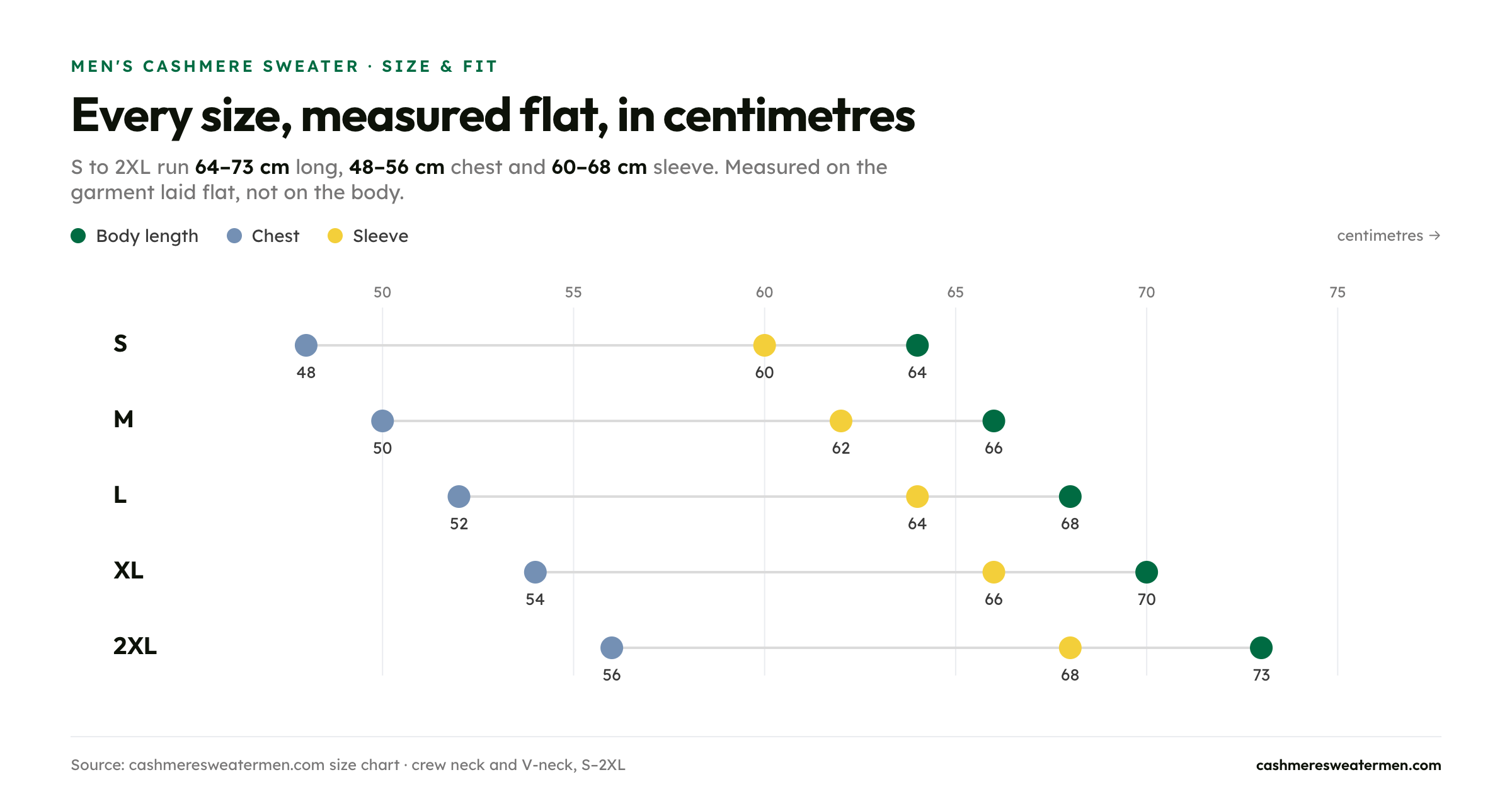
Every size in centimetres, with inches below. Measurements are of the garment laid flat, so the chest is half the way round. Double it for the full chest. Sleeve runs from the shoulder seam to the end of the cuff.
 Open full size
- Body length
- 64–73 cm
- Chest, flat
- 48–56 cm
- Sleeve
- 60–68 cm
- Sizes
- S–2XL
| Size | Body length | Chest (flat) | Chest (to wear) | Sleeve |
|---|---|---|---|---|
| S | 64 cm25.2 in | 48 cm18.9 in | 96 cm37.8 in | 60 cm23.6 in |
| M | 66 cm26.0 in | 50 cm19.7 in | 100 cm39.4 in | 62 cm24.4 in |
| L | 68 cm26.8 in | 52 cm20.5 in | 104 cm40.9 in | 64 cm25.2 in |
| XL | 70 cm27.6 in | 54 cm21.3 in | 108 cm42.5 in | 66 cm26.0 in |
| 2XL | 73 cm28.7 in | 56 cm22.0 in | 112 cm44.1 in | 68 cm26.8 in |
| Quarter zipone size only | 65 cm25.6 in | 50 cm19.7 in | 100 cm39.4 in | 60 cm23.6 in |
Every size adds 2 cm of chest and 2 cm of sleeve. Body length adds 2 cm a size, except 2XL, which adds 3 cm. So you cannot get more chest without more sleeve.
These sizes are for the Men's Crew Neck Cashmere Sweater and the Men's V-Neck Cashmere Sweater. The Men's Quarter Zip Cashmere Sweater comes in one size.
How to measure a sweater you already own
Compare a sweater to a sweater, not to your body. It takes two minutes and a tape measure.
- Pick the right sweater.A fine knit that fits the way you want this one to, not a chunky lambswool or a hoodie. If all your sweaters feel a bit tight, do not use one of those.
- Lay it flat, front up.On a hard surface, not a bed. Do up any buttons or zip. Smooth it out but do not pull it: a knit will easily give you 3 cm that is not there.
- Chest: straight across, 2.5 cm below the armholes.Seam to seam, tape flat and level. Compare it to the “Chest (flat)” column.
- Sleeve: shoulder seam to cuff edge.Start where the sleeve joins the body and run along the top of the sleeve to the end of the cuff. This is the measurement most likely to send a sweater back.
- Body length: shoulder to hem.Straight down the front. Use it as a rough check. Chest and sleeve decide the size.
- Match the chest, then check the sleeve.Pick the size closest on chest, then look at its sleeve. If the sleeve is more than 2 cm off, that is a full size, so decide which you would rather live with.
If you have nothing to measure
Buying a gift and cannot borrow one of his sweaters? Work from his chest measurement instead. More gift advice is on Cashmere Gifts for Men.
- Measure his chest.Tape under the arms, level all the way round, over a shirt, breathing normally.
- Halve it.That gives a flat half-chest you can compare to our chest column.
- Add ease.Ease is the gap between the sweater's flat chest and his half-chest. As a rough rule for knitwear: 2–3 cm feels close, 4–6 cm regular, and 8 cm or more relaxed, with room for a shirt.
A collared shirt underneath needs more room than a thin tee. See What to Wear Under a Sweater. A sweater for an air-conditioned office in June needs less ease than one worn over a shirt in January. More on Can You Wear Cashmere in Summer?
Worked example, on the real numbers
A 100 cm (39.4 in) chest halves to 50 cm. Our M is exactly 50 cm flat: no ease at all, tight over a shirt. The L at 52 cm gives 2 cm and feels close. The XL at 54 cm gives 4 cm and feels regular. So a 100 cm chest is an L for a close fit, or an XL for a regular one.
The quarter zip's free size, and who it will not fit
The quarter zip comes in one size: 65 cm long, 50 cm across the chest laid flat, 60 cm sleeve. Against the other sizes:
- The chest is an M: 50 cm, the same as the M crew and V-neck.
- The sleeve is an S: 60 cm, 2 cm shorter than the M and 4 cm shorter than the L.
- The length sits between S and M at 65 cm.
The collar is a standing funnel with a zip, the only one in our range. More on Funnel Neck Sweaters for Men.
Who the quarter zip will not fit
If you take an L, XL or 2XL in the crew or V-neck, it will not fit you. The chest is 2, 4 or 6 cm short, and there is no larger size.
If you have long arms, it will not fit you either, even with an M chest. The 60 cm sleeve is the shortest in the range.
It fits a man who takes an M in the chest and has S-length arms.
Why “true to size” tells you nothing
There is no standard for menswear sizing. An M is whatever each brand decides, and brands differ by more than a full size. So “true to size” only means true to that brand's own sizes, which you cannot know in advance.
Only measurements carry across brands. That is why we list every one, sleeve included. Two minutes with a tape measure beats the letter on any label.
Sleeve length is where sweaters fail
 Open full size
- S
- 60 cm
- M
- 62 cm
- L
- 64 cm
- XL
- 66 cm
- 2XL
- 68 cm
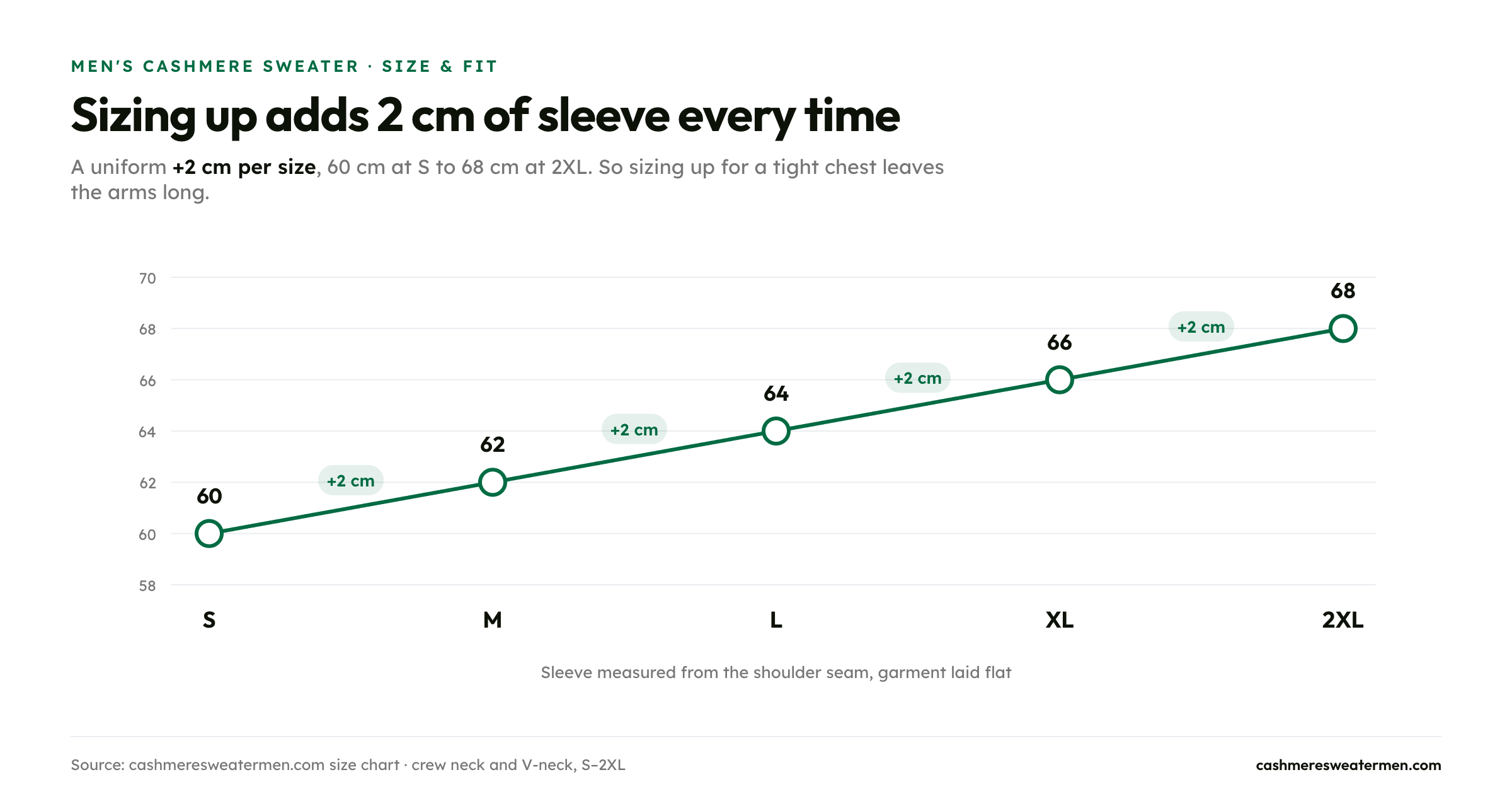
Sleeve grows with chest, 2 cm every size. Size up for a tight chest and you also get 2 cm more sleeve. Size down for long sleeves and you lose chest too. No size gives you a 2XL chest with an M sleeve.
A good cashmere sleeve ends at the wrist bone, with enough length to push up without pulling the shoulder. Too long and the cuff covers your hand, catches on desk edges and pills first. Does Cashmere Pill? explains why cuffs go first.
Who these sweaters will not fit
Our largest size is 2XL: 56 cm chest laid flat (112 cm, or 44.1 in, around), 73 cm long, 68 cm sleeve. We do not make anything larger, and the quarter zip will not fit most men who take an L or above.
We make three sweaters, knitted in our Pokhara workshop. Meet the makers on The Artisans Who Make Your Sweater.
If the size is wrong
We offer exchanges, not refunds. Tell us within 24 hours of delivery, then send it back within 15 days (7 days inside Nepal), unworn with tags and packaging on. You pay postage both ways, and exchanges depend on stock. Details on Returns & Exchanges.
Sizing sorted? Read How to Verify Your Cashmere Is Real and Does Cashmere Pill?
Common questions
Do these cashmere sweaters run small?
Go by the measurements, not your usual label. Our M is 50 cm across the chest laid flat, or 100 cm around. Lay a sweater you like flat, measure across the chest and match it to the chart. Between sizes? Take the larger.
How do I measure a sweater I already own?
Lay it flat, front up, on a hard surface without stretching it. Measure straight across the chest, seam to seam, 2.5 cm below the armholes. That is the flat chest in our chart. Then measure the sleeve from the shoulder seam to the end of the cuff, and compare both.
What size is the quarter zip?
One free size only: 65 cm long, 50 cm across the chest laid flat, 60 cm sleeve. That is an M chest with an S sleeve, and a length between S and M.
Should I size up or size down?
If you are between sizes, size up. A cashmere sweater that pulls across the chest rarely gets worn, and it will not stretch to fit you. The cost is 2 cm more sleeve, which is easier to live with than a tight chest.
Do these sweaters fit tall men?
It depends on your sleeve. We don't make big and tall sizes. Our largest, the 2XL, is 56 cm across the chest laid flat, 73 cm long, with a 68 cm sleeve. If you normally wear a tall or long-sleeve fit, measure the sleeve of a sweater you own and compare it with 68 cm. The quarter zip comes in one size only, with a 60 cm sleeve, so it may sit short on long arms.
What if the size is wrong?
We offer exchanges, not refunds. Tell us within 24 hours of delivery, then send it back within 15 days (7 days inside Nepal), unworn with tags and packaging on. You pay postage both ways, and exchanges depend on stock.