Free worldwide shipping over $100  ·  Knitted in Pokhara, Nepal  ·  Size exchanges within 15 days

Who makes this

About — Ethical Cashmere from Pokhara

This site sells three men's cashmere sweaters. They are made by Yes Helping Hand, a social enterprise that has been operating out of Damside-17, Pokhara, Nepal since 2011.

The short version. Yes Helping Hand is a Nepali social enterprise founded in 2011 by Dinesh Kumar Thapa, employing 180+ artisans. Cashmeresweatermen.com is its men's sweater catalogue, separated out so that men shopping for one sweater do not have to read a 500-product homepage. Orders are completed on yeshelpinghand.com.

Why this site exists separately

Yes Helping Hand sells shawls, ponchos, blankets, cardigans, wool jackets, cushion covers and paintings alongside its cashmere. If you arrived looking for one men's cashmere sweater in the right size and colour, most of that catalogue is noise.

So this domain does one job: it holds the three men's cashmere sweaters, every colour they come in, the measurements in centimetres, and honest answers about how cashmere behaves. Nothing here is a different product from what the parent sells. It is the same garment, described properly.

The checkout here is built but not switched on

There is now a bag and a checkout on this domain. The payment step behind it is not live yet: the card processor has no keys on this server, so it answers every attempt with “checkout is not configured” rather than pretending to take money. We would rather say that on the About page than let you find it at the last click.

So today there are two honest paths. Add a sweater to the bag here and we will pick the order up by email from Contact, or buy the same garment straight from the live listing on yeshelpinghand.com, where the order, the payment and the shipping already work. When the payment step goes live this box will change, and Terms of Service will say who you are contracting with.

Who Yes Helping Hand is

Yes Helping Hand was founded in 2011 in Pokhara by Dinesh Kumar Thapa, to create paid, skilled work for people who were being shut out of it — specially-abled individuals, single mothers, and women from marginalised and trafficked backgrounds. By 2023 it had trained more than 180 people. It runs on fair-trade and ethical-sourcing principles, and its own account of that two-decade arc is longer and better told than anything we would write here.

If you want the full history — the canteen and dormitory built for staff before 2014, the earthquake rebuilding work, the fair-trade recognition — read it at the source: About Yes Helping Hand. This page is deliberately the shorter, sweater-specific one.

What we actually make

The fibre is Chyangra cashmere — the Nepali cashmere goat — combed from herds grazing above 3,000 m in Mustang, Manang and Dolpo. It is Grade A, 12–16 micron. The sweaters are knitted in Pokhara.

We are careful with those words because a lot of the category is not. We do not say “hand-knitted”, because they are knitted on the workshop’s machines. We do not say “handloom-woven” either — a handloom weaves flat cloth, and that part of the workshop makes the shawls. We do not claim certifications we cannot show you. And we say openly that cashmere pills, that the first three wears are the worst of it, and that no sweater at any price is exempt — the whole argument is set out in Does Cashmere Pill?

2011Founded in Pokhara, Nepal
180+Artisans trained and employed
12–16 micronGrade A Chyangra cashmere
Damside-17The workshop address, not a PO box

Three sweaters is a small range, and that is the point

Most cashmere retailers you will compare us against list dozens of styles. We list three. A crew neck at $155, a V-neck at $155 and a quarter zip at $120. The crew comes in 14 colours, the V-neck in 13, the quarter zip in one.

That is not a curation story, it is simply what the workshop makes well. We would rather show you three garments with every measurement published than thirty with none.

The three sweaters. Prices are the parent's listed prices. Every price you see is read from one catalogue file on the server at the moment the page renders, so a stale bag cannot carry an old price.

The five numbers we leave blank

Every specification table on this site has five empty rows: ply, ply weight in grams, weight in GSM, gauge, and neck opening. They are marked “to be confirmed from the workshop” rather than filled in.

Those are precisely the numbers a buyer uses to judge whether a sweater is substantial, so leaving them out costs us sales. We leave them out because no men's sweater in the parent catalogue states them. The 8-ply muffler states its ply; the sweaters do not. We could copy a plausible figure from a competitor's listing and nobody would catch it. Guessing would cost more than the blank does, because the entire argument of this site is that the numbers on it are real.

The same rule governs a word rather than a number. We do not say “hand-knitted” anywhere, because our own sources disagree about which stages are machine and which are hand, and the flattering reading is not the safe one. That disagreement is written out in How to Verify Your Cashmere Is Real.

Specification rows: 10 of 15 stated with a source, 5 published blank (ply, ply weight, GSM, gauge, neck opening)
Ten of fifteen specification rows carry a figure. The other five — ply, ply weight, GSM, gauge and neck opening — are published as unconfirmed rather than estimated.
Rows stated
10 of 15
Published blank
5
The blanks
Ply, ply weight, GSM, gauge, neck opening

The full specification table

How we photograph colour

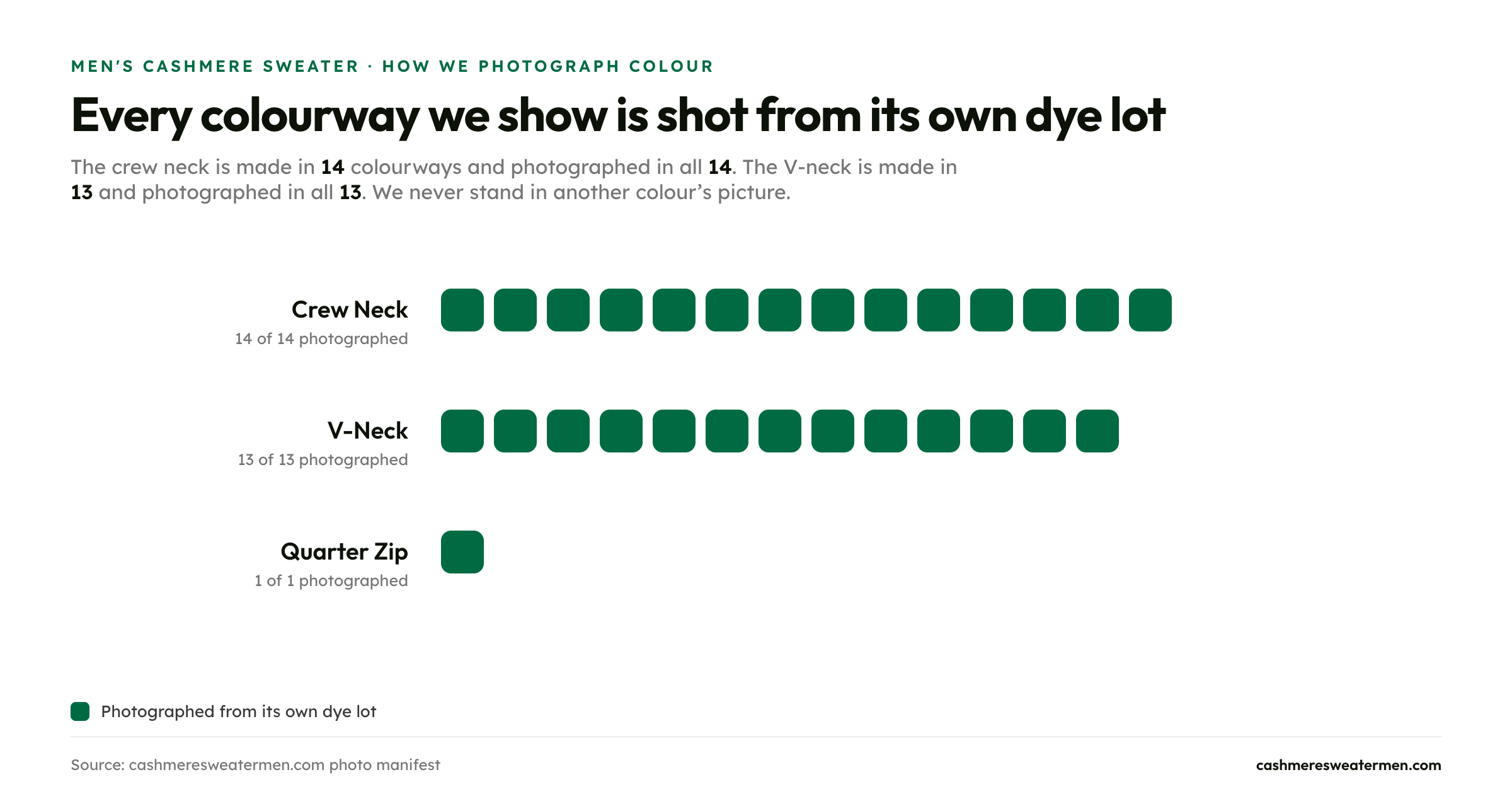
Every colourway photograph on this site is of the colourway it labels, shot from that colourway's own dye lot. Not one sample recoloured in software. The reason is the dyeing itself: the workshop dyes in small batches, batches drift between lots, and a single studio sample tinted fourteen ways would be a picture of a garment that does not exist.

The cost of that rule is that we cannot show you everything. The crew neck has fourteen colourways and fourteen photographs. The V-neck is made in thirteen and photographed in eleven — Sandstone and Oat have never been shot. So the colour picker on a product page offers only the colourways we can actually show you, and the page says which count is which rather than letting you find the gap. The full thirteen are still listed further down the V-neck page.

Colourways made versus photographed: crew neck 14 of 14, V-neck 11 of 13, quarter zip 1 of 1
The crew neck is made in 14 colourways and photographed in all 14. The V-neck is made in 13 and photographed in 11, so Sandstone and Oat stay unshown rather than borrowing another colour's photograph.
Crew neck
14 of 14 shot
V-neck
11 of 13 shot
Quarter zip
1 of 1 shot
Never shot
Sandstone, Oat

All 13 V-neck colourways

What this site will not sell you

This domain covers men's cashmere sweaters and the questions that belong to them: grade, micron, ply, origin, pilling, fit, care, what goes under one and what goes over it. That is the whole scope.

It is not the place for women's cashmere, cashmere blankets and throws, shawls, ponchos, scarves, yak wool, sheep wool or pashmina. The parent workshop makes several of those and sells all of them, and we would rather send you there than write a thin page to catch the search. If you are comparing cashmere against other fibres before you buy anything, the parent has the long-form comparisons — cashmere against merino and cashmere against pashmina among them.

When we are wrong, we change the page

Some of what is on this site came from reading the parent's own catalogue rather than from standing in the workshop, and reading can be wrong. Two things follow from that.

The first is that anything unverified is labelled unverified in place, not quietly omitted — the five blank specification rows, the construction term, the two unphotographed V-neck colourways, and the parts of the exchange policy still being settled on Returns & Exchanges. The second is that corrections are made to the page itself rather than appended as a footnote, and the page carries the date it was last checked. If you find something here that is wrong, tell us on Contact and we will change it or explain why we think it is right.

The people, not the process

The artisans are the part of this business that cannot be copied by a competitor with a better photographer. Their names, their workshops and what each of them actually does are collected on The Artisans Who Make Your Sweater.

Reaching us

The Pokhara workshop is a real address with a real phone number on it, and we publish both rather than a contact form and a PO box:

A Pokhara address is the point rather than an apology for one: it is where the sweaters are actually knitted. The remaining offices and hours are on Contact. Shipping timings from Nepal are set out honestly, including the slow weeks, on Shipping & Delivery, and the exchange terms — including the parts still being confirmed — are on Returns & Exchanges.