
Your sweater, specifically
How to Verify Your Cashmere Is Real
Run two quick tests at home: a rub test, and a burn test on a few fibres from an inside seam. Together they show whether the fibre is animal or synthetic, and fibre certification documentation for ours is available on request.
What the three words on our label mean
 Open full size
- Fibre diameter
- 12–16 micron
- Grade
- A
- Breed
- Chyangra
Three claims come with every sweater we sell. Here is what each one means.
100% cashmere
No wool, no acrylic, no nylon core. This is the one you can test yourself, with the burn and rub tests below. The other claims describe the fibre before it was knitted, which no test on the finished sweater can check.
Grade A
A trade grade for fine, long fibre. It is not a legal standard, and no government body issues it. Ours comes through our workshop's sourcing in Mustang, Manang and Dolpo. For how grading works, see Yes Helping Hand's cashmere grades and micron guide.
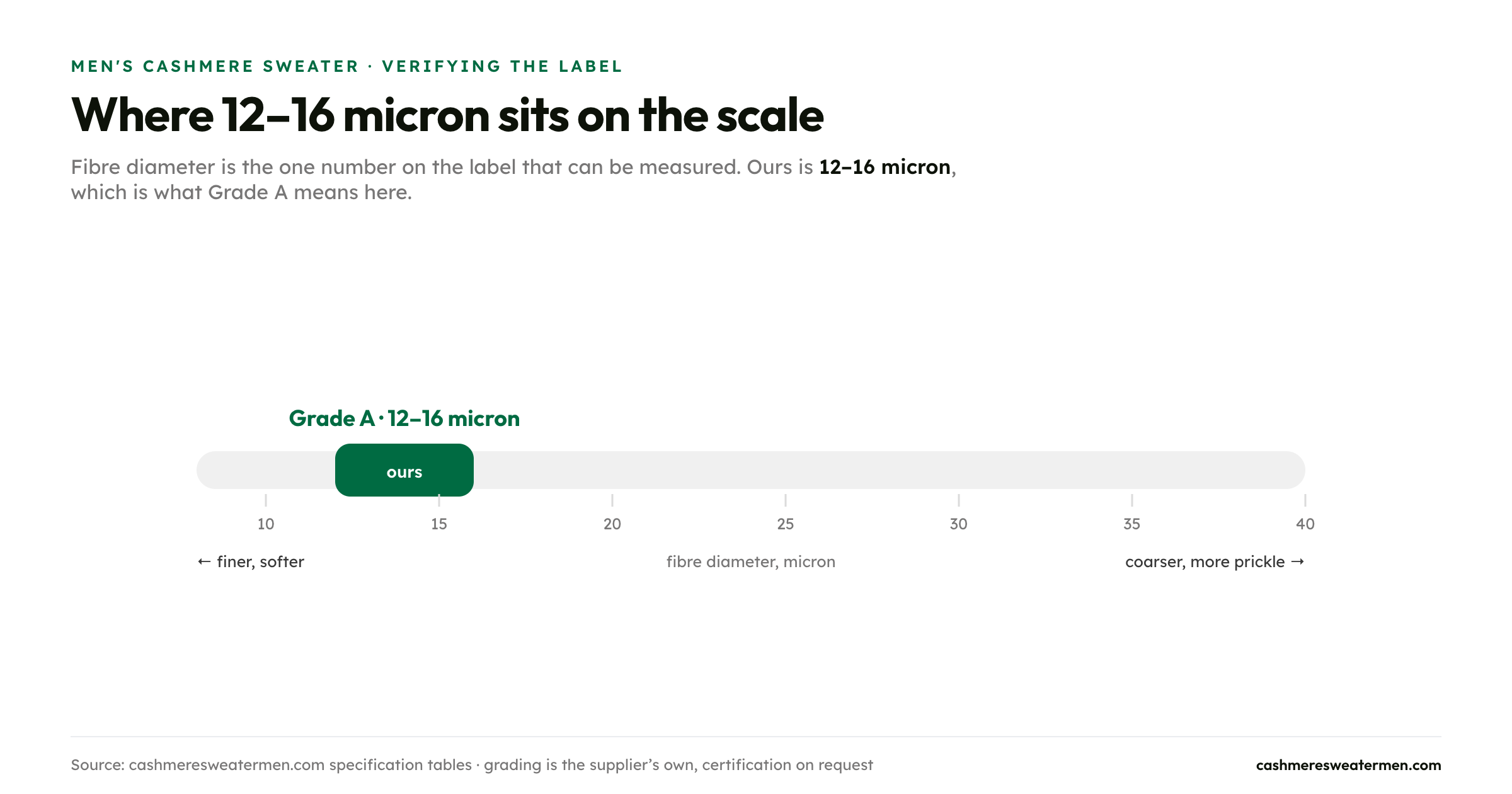
12–16 micron
Micron is the diameter of one fibre. Finer fibre feels softer, which is why cashmere costs what it does. It does not tell you how much cashmere is in the garment, and it does not predict pilling. Pilling depends on staple length, how long each fibre is, and finer fibre is often shorter. Does Cashmere Pill? explains more.
Chyangra
Nepal's cashmere goat. The fibre is the soft undercoat, combed out rather than sheared, from herds in Mustang, Manang and Dolpo above 3,000 m. The altitude is why the undercoat is so fine. No test on a finished sweater can prove where the fibre came from. You can see who made it on The Artisans Who Make Your Sweater, and where, on Himalayan Cashmere Sweaters, Made in Pokhara.
What the certificate does and does not prove
Fibre certification documentation is available on request. Ask us at [email protected].
A fibre certificate reports on a tested sample of fibre or yarn. It cannot prove the altitude a goat grazed at, the herd, or that the sweater in your parcel came from the tested lot. It is useful, but the two tests below tell you more about your own sweater.
The burn test, on a sweater you already own
The clearest yes-or-no test you can do. It destroys the fibres it tests, so only try it on a sweater you own.
Before you start. Work over a sink or a ceramic dish. Use tweezers, not your fingers. Take four or five fibres from the inside seam allowance, never from the outside of the knit or a cuff or hem. Keep loose clothing, hair and sleeves away from the flame.
Animal fibre: what yours should do
- Burns slowly, with a small flame
- Goes out on its own when you take the flame away
- Smells of burnt hair
- Leaves a brittle black ash that crumbles to powder
Acrylic, polyester or nylon
- Melts and shrinks away from the flame
- Keeps burning, or drips, after the flame is removed
- Smells of chemicals or plastic, not hair
- Leaves a hard, shiny bead you cannot crush
A blend does both: a hair smell with small melted beads in the ash. That result is worth acting on.
What it cannot tell you. The burn test separates animal fibre from synthetic. It cannot tell cashmere from merino, lambswool or yak, which all burn the same way. So it can rule out an acrylic blend sold as cashmere, but not wool sold as cashmere.
The rub test, and what it cannot tell you
Quicker, and it damages nothing. Rub a section of the body briskly between your palms for about ten seconds.
- Cashmere: a little short fibre lifts and the surface goes slightly hazy. No static. Nothing clings to your palm.
- Synthetic or synthetic-heavy blend: static builds, fibres cling to your hand, and the surface quickly balls into small, hard, tacky pills.
Two limits. Like the burn test, it tells you fibre type, not species or grade. And a little fuzz on a new cashmere sweater is normal. Loose fibres work free in the first two or three wears. Soft fuzz that combs away is fine. Hard, tacky balls are not. Does Cashmere Pill? has more.
What our construction looks like up close
Our sweaters are knitted in our Pokhara workshop. Turn one inside out and look at the shoulders, sides and underarms. You will see joined seams, because each sweater is knitted as separate panels and then assembled.
The panels are joined on a linking machine in our linking section, where Rina Gurung assembles about 14 garments a month. Those seams are how a shaped knitted sweater is built, not a shortcut.
On the outside, look for an even, matte surface with a faint halo of short fibre. Synthetic-heavy blends look shinier and feel cooler to the touch.
Expect slight colour differences between orders. We dye in small lots, so the same colour a year apart may not match exactly. That is normal, not a sign of a fake.
| Construction | Knitted in our Pokhara workshop, then linked, washed, mended and checked |
|---|---|
| Seams | Panels joined on a linking machine |
The Artisans Who Make Your Sweater shows each step and who works on it.
What we do not claim
- No NPIA certification. We hold none and have never claimed one. If you see it attached to our sweaters anywhere, it is wrong.
- No hand-linked seams. The panels are joined on a linking machine.
- No home test proves origin. Nothing you can do at the kitchen sink shows altitude, herd or country.
If you think something is wrong
If the burn test leaves melted beads, if the fabric builds static and forms hard pills in the first week, or if anything else does not match what we describe, tell us. Email [email protected] or use our Contact page.
If the problem is fit, see the Men's Cashmere Sweater Size Guide & Fit and Returns & Exchanges.
The broader question, answered elsewhere
Judging a listing from another brand? Yes Helping Hand, our workshop in Pokhara, has two guides: how to check real cashmere and cashmere grades and micron.
Common questions
How can I verify the cashmere sweater I bought from you is real?
Run two tests at home. The rub test: rub the fabric briskly between your palms for ten seconds. Synthetic builds static and balls into hard, tacky pills. The burn test: burn four or five fibres from an inside seam. Animal fibre goes out on its own, smells of burnt hair and leaves brittle ash. Acrylic and polyester melt, smell of chemicals and leave a hard bead. Neither test can tell cashmere from merino or yak.
What does Grade A cashmere actually mean?
It is a trade grade for fine, long fibre, not a legal standard. No government body issues it. Our Grade A fibre is 12–16 micron, from Chyangra goats in Mustang, Manang and Dolpo. Fibre certification documentation is available on request.
What does 12–16 micron mean?
Micron is the diameter of a single fibre. Finer fibre feels softer, and 12–16 micron is what makes cashmere feel like cashmere. Micron does not predict pilling. That depends on staple length, which is how long each fibre is.
Does the burn test prove my sweater is cashmere?
No. It proves the fibre is animal, not synthetic. Cashmere, merino, lambswool and yak all burn the same way. So the burn test can rule out an acrylic blend, but not wool sold as cashmere.
Do you provide a certificate of authenticity?
Fibre certification documentation is available on request. Email [email protected]. A fibre certificate reports on a tested sample, so it cannot prove the herd, the altitude, or that your sweater came from that lot.
Is the sweater NPIA-certified?
No. We hold no NPIA certification and have never claimed one. If you see it attached to our sweaters anywhere, it is wrong.