
Damside-17, Pokhara
The Artisans Who Make Your Sweater
Your sweater is knitted, joined, washed and mended by named people in our Pokhara workshop. Here they are, station by station. You will also meet eight more makers who weave our shawls and blankets. Each name links to that person's own story.
The four stations your sweater passes through
 Open full size
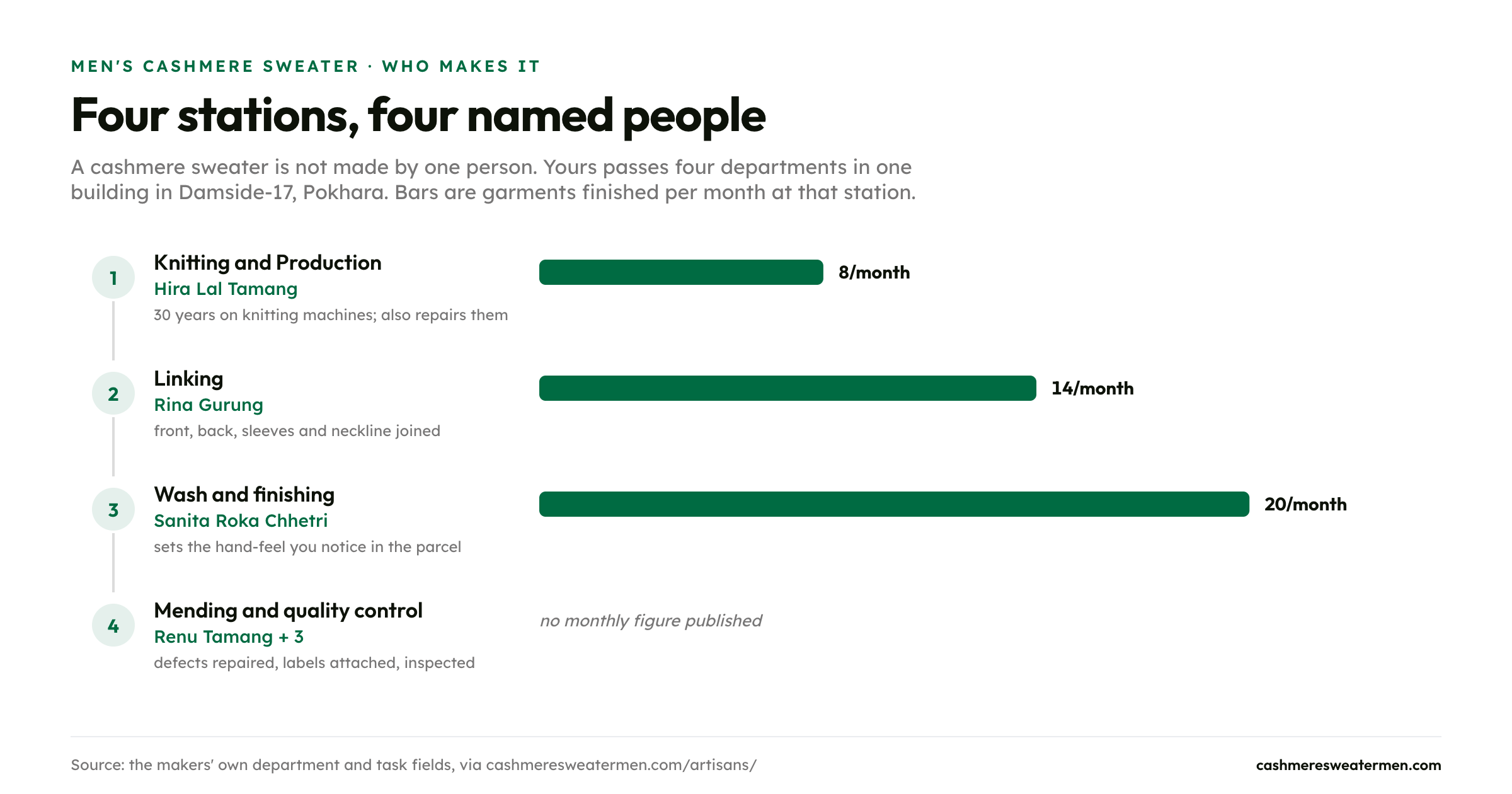
- Knitting
- 8/month
- Linking
- 14/month
- Wash & finishing
- 20/month
- Mending & QC
- no figure published
No single person makes a cashmere sweater. Yours passes through four departments in one building in Damside-17, Pokhara. Here is the order, and who works each station.
- Knitting and Production: Hira Lal TamangThe panels are knitted on industrial knitting machines. Hira Lal ran knitting machines in a Kathmandu clothing factory for 30 years before he came to Pokhara. He also repairs the machines when they stop. He completes about eight cashmere garments a month.
- Linking: Rina GurungThe front, back, sleeves and neckline are joined into one garment on a linking machine. Every sweater and cardigan in the workshop passes through this station. Rina assembles about 14 garments a month.
- Wash and finishing: Sanita Roka ChhetriThe assembled garment is washed and finished. This step sets how the sweater feels when you open the parcel. Sanita handles about 20 pieces a month.
- Mending and quality control: Renu Tamang, Tulsi Sunar, Maina Thapa and Inn Kumari PoudelAny defects are repaired, labels are attached, and the sweater is checked before it is packed. Renu Tamang is the maker Yes Helping Hand names on all three men's sweaters: the crew neck, the V-neck and the quarter zip.
The eight makers on the sweater line
These eight work on sweaters and cardigans at one of the four stations. The monthly figures come from their own profiles.
Hira Lal Tamang
Knitting / ProductionKnits cashmere sweaters, joggers and trousers on industrial knitting machines. Also repairs and maintains all knitting equipment.
- Output: About 8 cashmere garments a month
- Supports: A family of seven
From Kavre. Drove a taxi in Kathmandu, then operated knitting machines in a Kathmandu clothing factory for 30 years before moving to Pokhara. Needed no training when he joined.
He also looks after the machines. When a knitting machine stops, he is the one who gets it going again.
Read Hira Lal Tamang's story on yeshelpinghand.com
Rina Gurung
Linking SectionAssembles knitted panels into complete sweaters and cardigans using a linking machine. Joins front, back, sleeves and neckline into one garment.
- Output: About 14 assembled garments a month
- Supports: A family of four
Lost her mother five days before her grade 10 board exams and raised her three-year-old brother instead of finishing school. Later endured an abusive marriage and raised her daughter alone. Trained in machine linking at the workshop.
Read Rina Gurung's story on yeshelpinghand.com
Sanita Roka Chhetri
Wash SectionHandles washing and finishing of completed garments. Also knits cashmere sweaters for women, and caps.
- Output: About 20 cashmere pieces a month
- Supports: A family of four
Became the sole provider for her family overnight when her husband was paralysed. Had no formal skills; joined the workshop's free training programme and became skilled in both knitting and finishing.
The sweaters she knits are for women. On yours she does the wash and finish, the step that sets how the sweater feels when you open the parcel.
Read Sanita Roka Chhetri's story on yeshelpinghand.com
Renu Tamang
Mending SectionMends and finishes cashmere sweaters, ponchos and wool jackets. Repairs any defects before packaging.
- Output: About 22 finished pieces a month
- Supports: A family of three
Fell from a tree and broke her spine 20 days before the 2072 BS earthquake, and was paralysed from the waist down. Recovered through multiple surgeries and still lives with two steel rods in her spine. Received three months of free training with a food allowance. She walks two hours each way to the workshop.
Read Renu Tamang's story on yeshelpinghand.com
Tulsi Sunar
Mending SectionInspects and mends cashmere sweaters, cardigans and coats before they are packed. Repairs any knitting defects.
- Output: About 22 pieces a month through quality control
- Supports: A family of three
Lives with a spinal disorder that limits her movement, and became the sole breadwinner for her family regardless. Trained in mending and quality control at the workshop.
Read Tulsi Sunar's story on yeshelpinghand.com
Maina Thapa
Mending SectionAttaches buttons and labels to cardigans and sweaters. Final mending and finishing before packaging.
- Output: About 28 finished pieces a month
- Supports: A family of three
Left school after grade 3. Raised two children alone for 18 years, cooking at a hotel and then cutting meat and cleaning at a food business before joining the workshop.
Our men's sweaters have no buttons, so on yours she does the labelling and the final mend.
Read Maina Thapa's story on yeshelpinghand.com
Inn Kumari Poudel
Mending SectionFinal quality inspection on shawls, stoles, blankets and ponchos. Also mends and finishes sweaters.
- Output: About 28 finished pieces a month through QC and finishing
- Supports: A family of five
Originally from Raipur, Tanahun. Her husband disappeared 25 years ago and was never traced; she raised her son alone, moved to Pokhara for his education, and joined the workshop's free three-month pashmina and cashmere training programme.
Her quality checks cover the handloom and pashmina pieces. On sweaters she mends and finishes.
Read Inn Kumari Poudel's story on yeshelpinghand.com
Sunita Tamang
CreationsKnits sweaters by hand on the Creations line, plus wool gloves, socks, leg warmers and wool jackets.
- Output: About 14 pieces a month across cashmere and wool
- Supports: A family of three
Cannot read or write; learned to sign her name. Carried bricks and sand on construction sites, with her two daughters beside her, before she was trained at the workshop. Her husband left when she gave birth to daughters rather than a son.
Her hand knitting is for the Creations line. Our men's sweaters are machine-knitted and joined on a linking machine.
Read Sunita Tamang's story on yeshelpinghand.com
Eight more makers in the workshop
Our handloom, artisan and pashmina sections weave shawls, stoles, ponchos, mufflers and blankets. These eight makers do not work on the men's sweaters, but they share the same workshop, and their stories are part of ours.
Bikash Poudel
Handloom Section (in charge)Weaves cashmere shawls, ponchos, mufflers and blankets on a traditional handloom. Trains and supervises the other handloom weavers.
- Output: About 8 handwoven pieces a month
- Supports: A family of eight
Deaf and mute, as are his brothers and sisters. Took nine months to learn a handloom skill most people learn in two or three, then went on to train more than 15 other weavers and to lead the section. He is also the person called when a loom breaks.
Read Bikash Poudel's story on yeshelpinghand.com
Atul Harijan
Handloom SectionWeaves cashmere stoles, shawls, mufflers and throws on a traditional handloom.
- Output: 8 to 10 handwoven cashmere pieces a month
- Supports: A family of five
Deaf and mute since birth. Left school after grade 6 and started work on a Kathmandu handloom at 13; eleven years of experience meant he needed no training when he joined.
Read Atul Harijan's story on yeshelpinghand.com
Krishna KC
Handloom SectionWeaves cashmere shawls, ponchos, mufflers and large blankets on a traditional handloom.
- Output: About 7 handwoven pieces a month
- Supports: A family of eight
Born in Baglung, one of four sons and the only one who is deaf and mute. Finished high school, learned sign language at school, and now handles some of the largest pieces including king-size blankets.
Read Krishna KC's story on yeshelpinghand.com
Ashok Gupta
Handloom SectionWeaves large cashmere scarves, lightweight shawls and multicolour stoles on a traditional handloom.
- Output: About 6 handwoven pieces a month
- Supports: A family of six
Deaf and mute; his wife is too. From Bilaspur, Palhinandan. Education stopped after grade 6. Worked in agriculture and in a Kathmandu factory, and made and sold bags, before taking up cashmere weaving.
Read Ashok Gupta's story on yeshelpinghand.com
Bhuwani Prasad Upadhyay
Artisan SectionCrafts cashmere ponchos with detailed designs, including leather accents, turtle neck styles and funnel neck patterns.
- Output: About 7 artisan poncho pieces a month
- Supports: A family of four
Born deaf and mute in Syangja and studied to grade 8. Painted serpents to sell at Nag Panchami before the workshop found him; his painting is what got him noticed, and he was given three months of handloom training with a food allowance.
Read Bhuwani Prasad Upadhyay's story on yeshelpinghand.com
Durga Sharma
Artisan SectionWeaves cashmere stoles with embroidery and detailed patterns, and crafts embroidered ponchos and specialty garments.
- Output: About 6 artisan pieces a month
- Supports: A family of three
Studied to grade 10. Raised a daughter and a son alone for four years, working as a sweeper and house cleaner, until she saw a workshop pamphlet and enrolled in the free three-month training.
Read Durga Sharma's story on yeshelpinghand.com
Dipak Bashyal
Pashmina Manufacturing CentreProduces the highest-value pieces in the collection: Jamawar shawls, needle-work stoles and embroidery paisley stoles.
- Output: About 3 to 4 fine embroidery pieces a month
- Supports: A family of four
Deaf and mute, and the only person in his family with a disability. Completed high school. He is the only maker entrusted with the Jamawar shawl line.
Read Dipak Bashyal's story on yeshelpinghand.com
Kamli Badai
Pashmina Manufacturing CentreProduces cashmere embroidery stoles, silk embroidery shawls and baby blankets on the pashmina line.
- Output: About 6 handcrafted cashmere pieces a month
- Supports: A family of three
Deaf and mute since birth, and the breadwinner for her family from a young age. Learned the pashmina craft in two and a half months.
Read Kamli Badai's story on yeshelpinghand.com
Machine work and hand work
- Knitted, not woven. Our sweaters are knitted on machines in the Knitting and Production department, where Hira Lal Tamang works. The handloom section is a separate part of the workshop. It weaves shawls, ponchos, mufflers and blankets.
- Machine-linked seams. Rina Gurung joins the panels on a linking machine.
- Mended and checked. The mending section repairs any defects, attaches the labels and checks every sweater before it is packed.
- Fibre documentation. Certification documents for the fibre are available on request. See How to Verify Your Cashmere Is Real.
- Their photos stay with them. We do not show the makers' photos here without their permission. You can see them on each maker's own profile.
More than 180 artisans
 Open full size
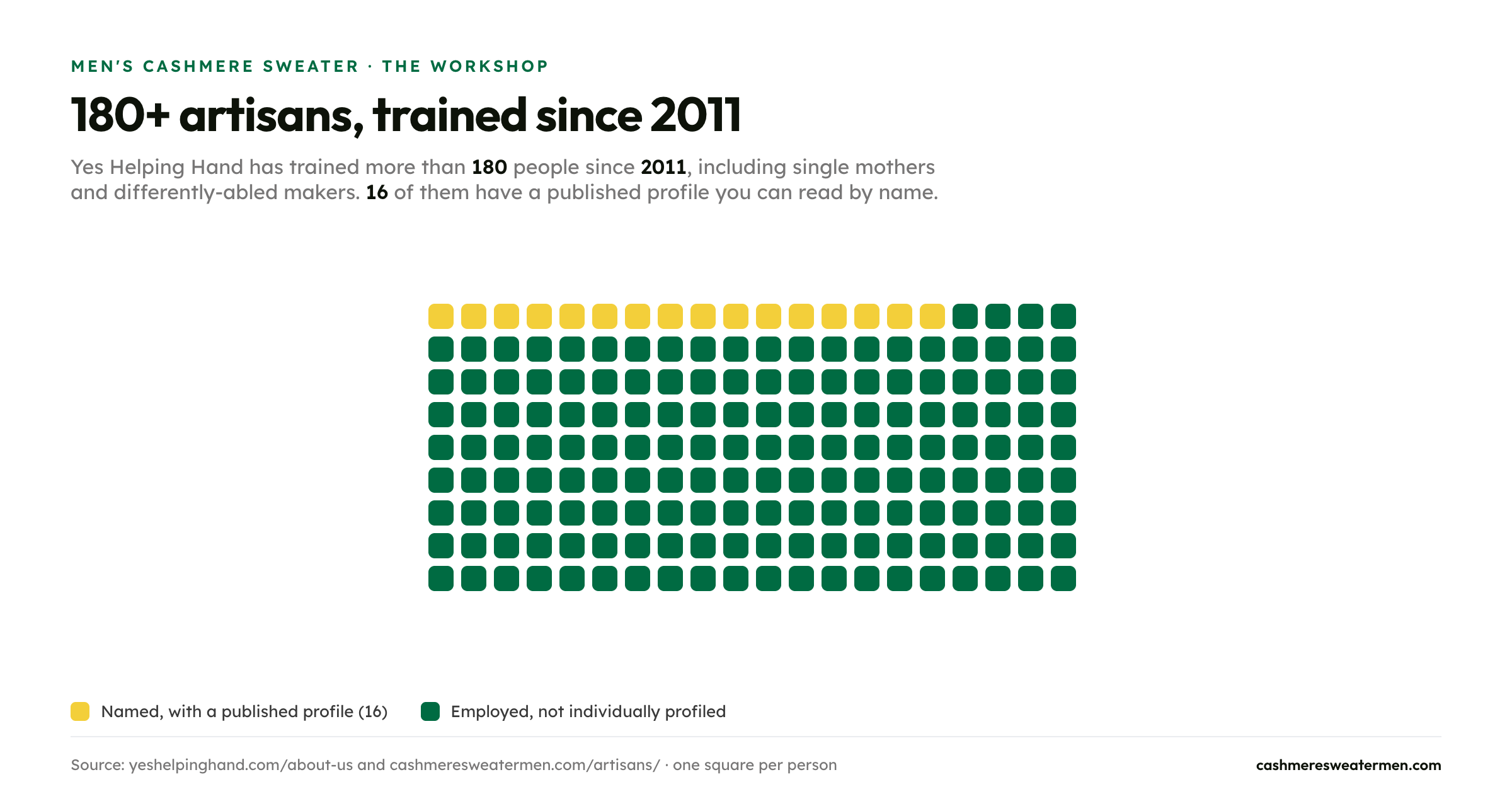
- Artisans
- 180+
- Since
- 2011
- Named profiles
- 16
Yes Helping Hand has worked with more than 180 artisans since 2011. Sixteen have a published profile, and all sixteen are on this page.
Among the sixteen, seven are deaf, five are single mothers and two live with spinal injuries. One supports a husband who is paralysed. Several joined through the workshop's free three-month training programme. Hira Lal and Atul needed no training at all, after years at a knitting machine or a loom.
The three sweaters they make. Renu Tamang is named on all three.
- Men's Crew Neck Cashmere Sweater: $155, 14 colours, S–2XL
- Men's V-Neck Cashmere Sweater: $155, 13 colours, S–2XL
- Men's Quarter Zip Cashmere Sweater: $120, one free size
Before you order, check the Men's Cashmere Sweater Size Guide & Fit. The quarter zip comes in one size, so compare its measurements with a sweater you own.
Common questions
Who actually makes my cashmere sweater?
Four stations and at least four named people. Hira Lal Tamang knits the panels in the Knitting and Production department. Rina Gurung joins the front, back, sleeves and neckline on a linking machine. Sanita Roka Chhetri washes and finishes the garment. Renu Tamang and the mending section repair any defects, attach the labels and check it before it is packed.
How many artisans can you name?
Sixteen. More than 180 artisans work with Yes Helping Hand, and sixteen of them have a published profile with their department, their work and their monthly output. Those sixteen are on this page.
Is my sweater made by one person?
No. It passes through four stations: knitting, linking, washing and mending. Different people work each one.
Is the sweater hand-knitted?
No. Our sweaters are knitted on machines in the Knitting and Production department, where Hira Lal Tamang works. Handloom weaving is a different craft. Our handloom section weaves shawls, ponchos and blankets, not sweaters.
Are the seams hand-linked?
No. Rina Gurung joins the panels on a linking machine, as her profile describes.